
3.3M views in one month:
what actually happened before, and after

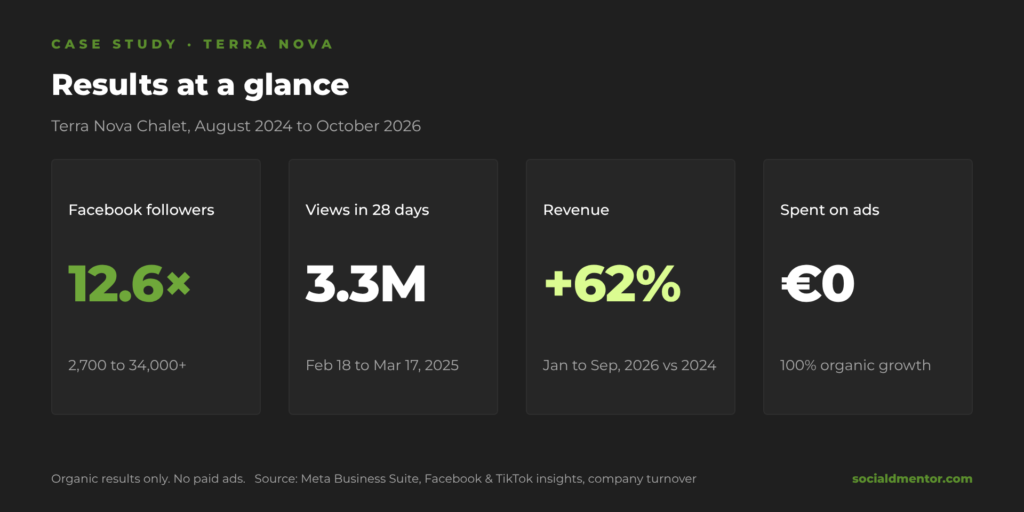
Everyone notices the 3.3 million views. Few see the six months of groundwork before them, or the growth that kept going after. This is the full story of how a mountain chalet went from 2,700 to 34,000+ Facebook followers and grew its revenue by 62% in two years, without spending a single euro on ads.
The starting point
When I stepped in at the end of August 2024, Terra Nova was in a hard spot. Guests came from only two places: Booking.com and past guests who came back or recommended it to friends. It was mostly the same people, year after year. Summer and winter were busy, and the rest of the year the chalet was almost empty. Almost nobody new was finding it, and it sits in the mountains, at least an hour from the nearest big city.
The place itself was never the problem. Mountain views from every window, a pool, a fireplace for cold evenings: it was all there. What was missing was a clear story and a reason to book directly.
- No clear positioning. It looked like one more guesthouse in a region full of them.
- No way for new guests to find it. Booking.com was the only online channel, and word of mouth only reaches people who already know you.
- A website that didn’t answer guests’ questions or guide them toward booking.
- A Booking.com listing with outdated, poor-quality photos, errors, and missing tags, on the one platform where new guests could find the chalet online. The photos showed rooms, not the feeling of staying there.
- No team and almost no budget. Paid ads were not an option, and neither was hiring help.
I took on the whole project, from positioning to the last caption, including giving the brand a face (I’m in many of the videos you’ll see there). No ads, no team, just strategy and consistency. Here’s what changed things for the chalet.
The strategy: five decisions that shaped everything
1. Sell the feeling, not the room
Instead of competing on price, I positioned Terra Nova as a premium escape. On Booking.com, I replaced every photo with images that show the feeling of the brand: warm light, a window full of mountains, coffee by the fire. I also fixed the listing itself: errors, missing tags and outdated details. Then I made sure every platform Terra Nova owns tells the same story. The website, Facebook, Instagram and TikTok share one message, one tone and one look, so a guest recognizes Terra Nova wherever they find it. The message everywhere: this is where you come to slow down.
2. Go where the guests already are
The guests most likely to book are 35+, often families, and they spend most of their time on Facebook. That’s why Facebook became the core platform. Meanwhile, Instagram and TikTok stayed active, but as support channels rather than priorities.
3. Talk to the person who plans the trip
In most couples and families, a woman plans the getaway and makes the case for it. So the content speaks to what she needs: peace, quiet and time for herself. Much of it is made to be shared, like the video “A message for my husband: LISTEN!”. A woman runs toward the best view of the chalet, followed by moments around the property, each timed to a song about being taken somewhere special that few people know. It’s a message she can send straight to her partner, and that share is often the first step toward a booking. The video alone reached 68,469 views, 135 new followers, 289 clicks and 63 saves.
4. Invite people in instead of describing the place
Nobody shares a list of amenities. People share a feeling. So instead of “we have 9 rooms and an apartment”, the content puts the viewer inside the experience. Mostly short vertical videos, filmed on a phone, with a real person in the frame.
5. One idea, three platforms
Rather than creating everything three times, I adapted every core idea for Facebook, Instagram and TikTok. In other words, it was the same message in a different format for each platform.
Before the 3.3M: six months of groundwork
Phase 1: Foundation (September 2024 to February 2025)
Rebranding, positioning, website structure and information, new photos and a cleaned-up listing on Booking.com, and one consistent look and message everywhere guests look. In parallel, I kept posting and testing formats to learn what this audience actually responds to.
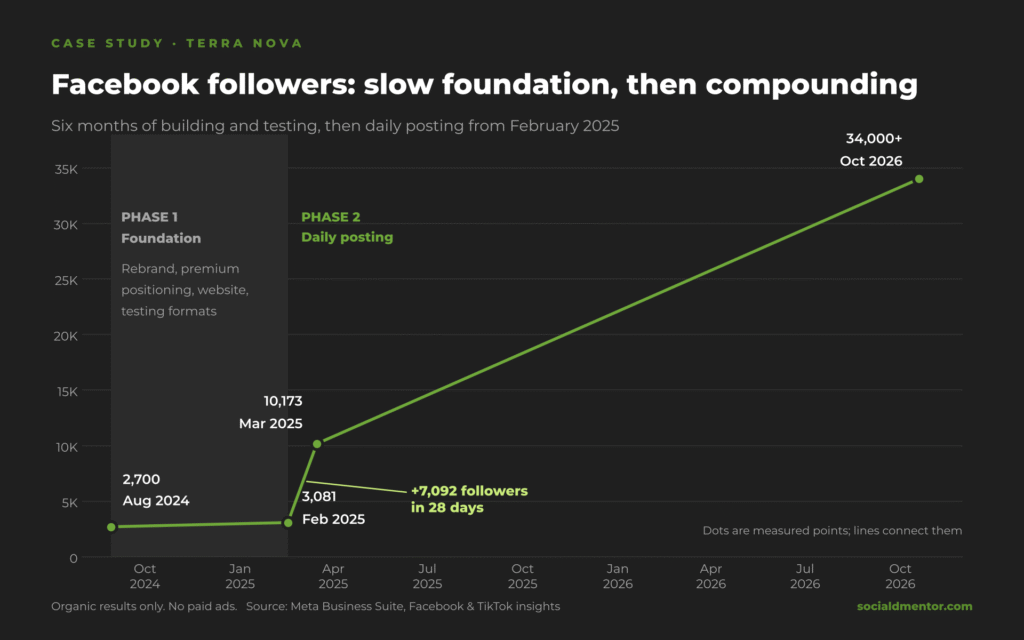
Growth in this phase was slow, and that was expected. Facebook went from 2,700 to 3,081 followers. Instagram went from 1,872 to 2,518. This is the phase where most businesses give up, because the work is real and the numbers don’t show it yet.
Phase 2: Daily posting (from February 2025)
Once the foundation was in place, I committed to posting every day. The website was easy to use, the strategy and content were set, and I knew which formats worked. Within four weeks, the page took off.
Most businesses rush into posting or paying for ads. But if social media is how you get clients, and you send them to a weak website with unclear information and no real invitation into the brand, you lose them. In the long run, that costs you more than waiting. You can learn more about it here.
The breakout month: the 3.3M
Between February 18 and March 17, 2025, the Facebook page reached 3.3 million views and 1.6 million people. 97% of those views came from people who didn’t follow the page yet.
Two videos carried most of it. The first reached 1.3M views. The second, built on the same format with a few deliberate tweaks, reached 1.5M. The page gained over 7,000 followers in 28 days.

Viral is not a strategy. Those two videos didn’t create success out of nothing. They landed on a foundation that was ready: clear positioning, a website that answered questions, a phone number in every bio. So when the attention came, it turned into calls, not just likes.
The audience followed the strategy
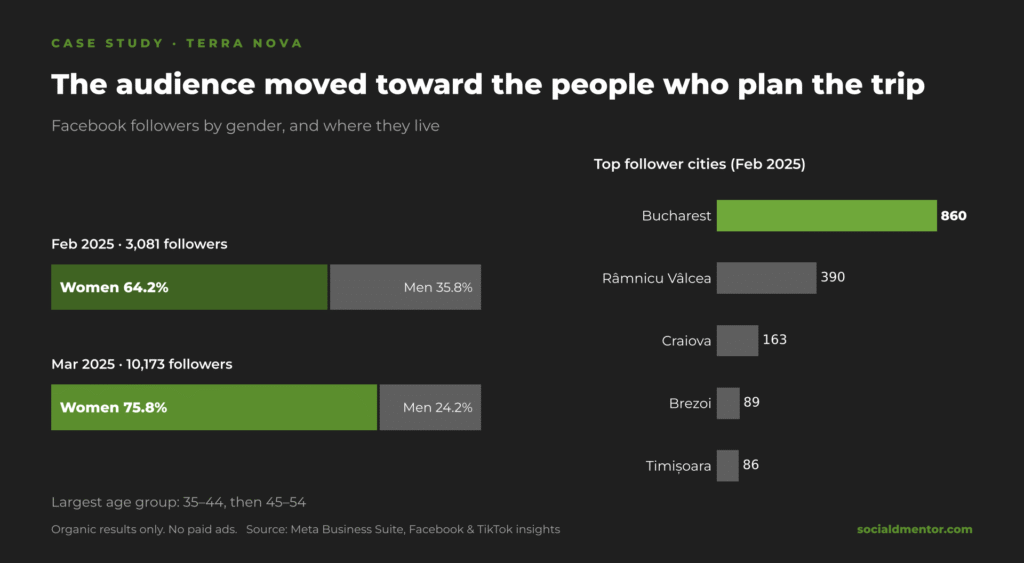
In February 2025, 64% of the Facebook audience were women. After the breakout month, it was 76%, led by the 35 to 44 and 45 to 54 age groups. That is exactly the person the content was made for.
The largest group of followers lives in Bucharest, a busy, crowded capital a few hours’ drive away, where people often need to get away from the noise. The second-largest group is in Râmnicu Vâlcea, the city closest to the chalet. A city audience looking for a weekend escape is the ideal guest for a mountain chalet.
After the spike: growth didn't stop
Spikes usually fade. This one didn’t, and that’s because the work didn’t stop once the numbers got exciting. The daily posting continued, along with high-quality content, keeping up with the latest trends, and constantly refining what worked.
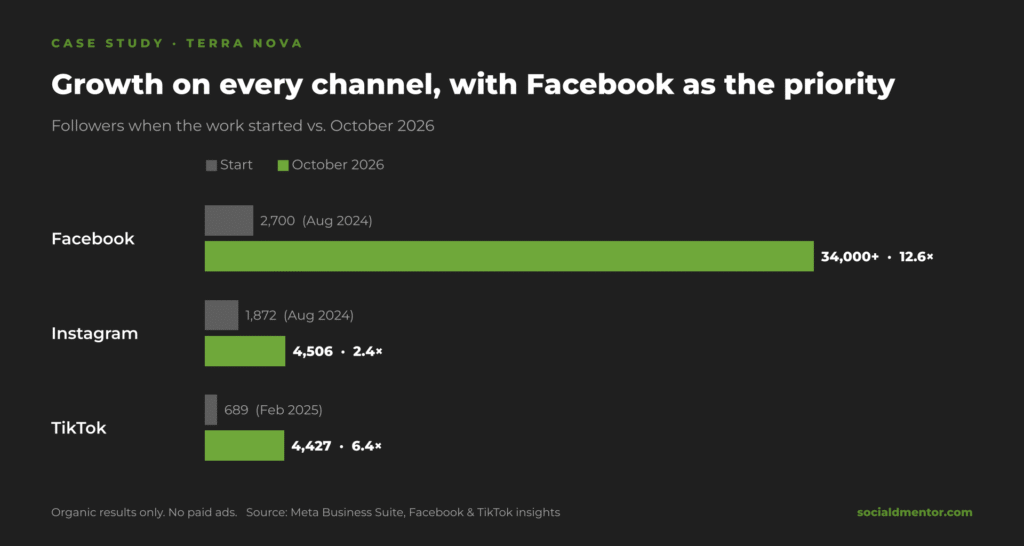
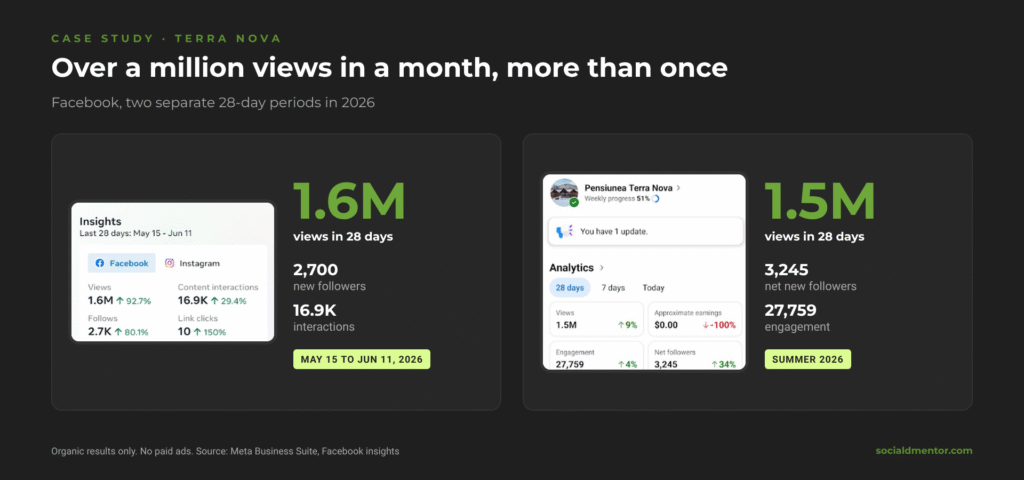
Two years in, the page is still growing. In the first 19 days of October 2026, Facebook brought 399.9K views and 907 new followers. In its strongest months, the page passes a million: 1.6 million views and 2,700 new followers between May 15 and June 11, 2026, and 1.5 million views with 3,245 net new followers in another 28-day period this summer. 98% of views come from Reels and 85% from people who don’t follow the page yet. In other words, new potential guests discover Terra Nova every single day.
What really matters: revenue
Views and followers are nice. Revenue pays the bills.
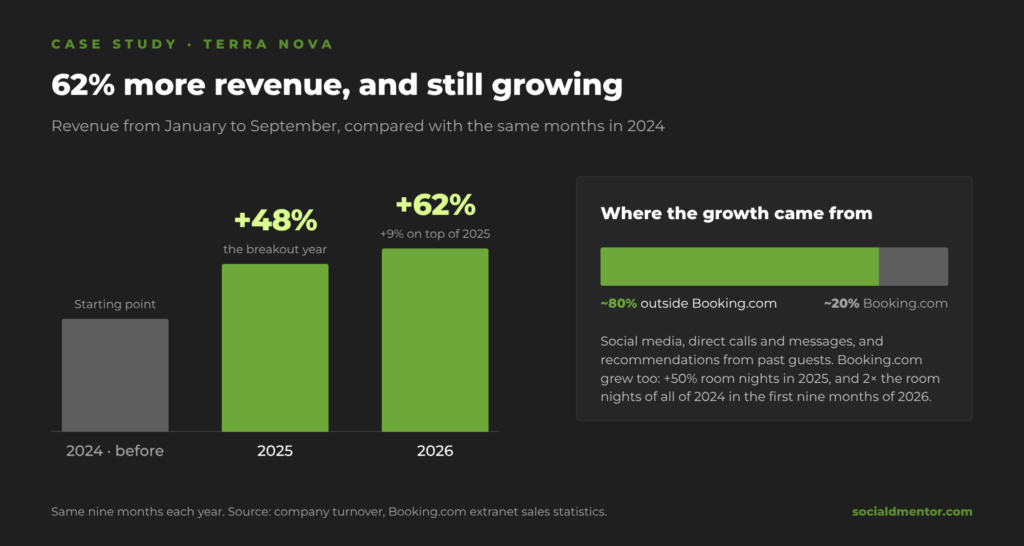
2026 isn’t over yet, so to compare fairly, I looked at the same nine months, January to September, in each year. 2024 is the before: I only stepped in at the end of August.
- 2024: the starting point
- 2025: +48%, the year of the breakout
- 2026: +62% compared to 2024. Another 9% on top of 2025.
That last line matters most. Viral spikes fade. Revenue that keeps growing a year after the viral moment is the sign of a system, not luck.
Where the extra money came from
Booking.com grew too, and that’s the new photos and the cleaned-up listing at work. Room nights booked through Booking went up 50% in 2025. In just the first nine months of 2026, there were already twice as many as in all of 2024.
But Booking.com is the smaller part of the story. About 80% of the extra revenue came from outside it: guests who found Terra Nova on social media, called or messaged directly, or came recommended by someone who stayed there. Two years ago, outside Booking.com, word of mouth was almost the only source.
Every guest who books directly also means no commission paid to a platform, so each one is worth more to the business.
One honest note: until now, nobody tracked exactly where each direct booking came from. From January 2027, every booking is logged by source, so the next update of this case study will show exactly how much comes from social media.
All of this happened without a single euro spent on ads. Which also means there is a lot of room left. With this organic foundation in place, paid campaigns would multiply something that already works, instead of trying to fix something that doesn’t.
What you can take from this
- Your product may not be the problem. Your story might be. Terra Nova didn’t change its rooms. It changed how it shows them.
- Pick the platform where your buyers already are, and commit to it. Being everywhere equally usually means being nowhere.
- Know who makes the decision, and talk to them. For Terra Nova, that was women aged 35 to 54 planning a getaway.
- Feelings get shared. Features get scrolled past.
- Know what you’re doing, then keep doing it. Strategy without consistency gives you random spikes. Consistency without strategy gives you random results.
- Build the foundation before you chase reach. Attention only turns into bookings when the basics are already in place.
See it for yourself
With most clients, I build the strategy and set up their team to run it. Here, I ran it myself, so every result on this page is a decision I made and tested. You don’t have to take my word for it. The chalet is still under my management, and the strategy still runs without ads, so you’re welcome to follow along and see it for yourself. The pages are live, and they keep growing:


Want this kind of growth for your business?
Whether you run a guesthouse, a hotel or a growing brand, it starts with the same thing: clarity about who you’re talking to and why they should care. Book a free 15-minute intro call and let’s find out where your growth is hiding.
